
What To Expect At Public Viewing Night
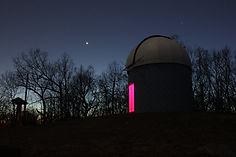
On the 3rd Friday of each month, SHAA members volunteer at the Observatory to run a Public Viewing Night. Our main goal for these nights is to allow as many people as possible to get a view of some beautiful objects through the big telescope in the Observatory. Perhaps some of you will catch the astronomy bug and join our club or maybe you are bringing your family to take a look at Saturn. Whatever brings you to Sheep Hill from near or far, our volunteers are here to share what we love with you!
Here are a few things that you should know before you come to one of our Public Nights:
-
There are two unpaved and unlit lots for visitors to park in.
-
We have to postpone/cancel public nights if the sky is not clear, or if the lots are icy. If Friday is cloudy, we postpone until Saturday. If Saturday is cloudy, we cancel until the next month.
-
There will probably be a wait to get up into the Observatory! Our visitor numbers can range between 30-250 guests for the public nights, and the more people that show up at once, the longer the wait. If you are bringing small children, it might be best to come right at the beginning, so you do not have a long wait. If you do not mind staying up later, you might avoid the rush by showing up a little later in the evening. We do not have a set closing time. Our volunteers will stay until everyone has had a chance to look through the telescope so the closing time varies depending on how many guests we have and what time of year it is.
-
There are no restrooms , no heat or air conditioning and no handicapped accessibility at the Observatory. It is a domed building with a steep stairwell up to the 2nd floor where the telescope is located. The dome opens up and rotates. We move it around depending on where in the sky we are pointing the scope.
-
We move the telescope in all directions and to different angles, so visitors should be prepared to climb a sturdy ladder to get their eye near the eyepiece, if necessary.
-
All of us will need our eyes to be adjusted to the dark to be able to get the best view through the scope, so please avoid shining any flashlights or using your cell phone with a bright screen, especially up in the dome. We do have red lights lining the stairs and up in the dome, as they do not affect your night vision. If you think you need a light to get around, please only use a red one. Likewise, turn your flash off if you are taking photos!
-
There is no seating area, so if you want a chair to sit in while you wait, you are welcome to bring one.
-
We simply can not start observing until it is dark. Our start time is different every month, because the sun sets at a different time. Please do not arrive until the posted time, as volunteers will not be ready for guests until that time.
-
Please do not come up the Observatory stairs until a volunteer calls your number/invites you.
-
When you arrive, head to the front door of the Observatory, and a member will issue you a sticker with a number on it. A volunteer will call small groups of 10-15 to the Observatory in the order they got their stickers.
-
Each small group will observe two objects during their time up in the dome and will be up there for 20-30 minutes. Different groups might look at different objects, depending on what is visible at that time of year/night. The volunteers in the dome will explain what you are looking at and answer any questions you might have to the best of their ability.
-
Our volunteers outside will set up various smaller telescopes on the front lawn. Another volunteer is also happy to do a "sky tour" with small groups, pointing at stars, constellations and planets with a laser! After you grab your number, you are free to walk around and take a peek through the telescopes outside, listen to the sky tour, or just hang out.
-
Take advantage of our volunteers' knowledge! None of us are professional astronomers, but we are happy to answer any questions that we can!
-
Sign into our guestbook on the first floor! We sell SHAA T-shirts for $20 each and there are donation boxes. We accept cash or Zelle payments (info@sheephillastro.org).
-
If you decide you want to become a member of our club, there is an online form or you can fill out a hard copy at the Observatory.
-
MANAGE YOUR EXPECTATIONS! There are a lot of beautiful images on the internet and even on our social media pages but what you see through a telescope is not going to look like those photos. Astrophotography involves multiple long exposures (often HOURS of exposure) stacked and processed to bring out color and detail. Visual astronomy is not going to give you that level of color or detail. A stacked and processed image of Saturn from our telescope and what it looks like visually through a telescope (cell phone photo) is posted below.

